Welcome to Mana Precast
Battery Mould (Main-Sub Mould System) for Precast Concrete Production
To meet the increasing demand for precast concrete components, and considering local environmental conditions, plant layout, and labor costs, the Battery Mould (Main-Sub Mould System) has been developed as an efficient and scalable production solution. The system is designed to meet current production requirements while allowing for future expansion to accommodate a wider range of precast elements.
By optimizing mould utilization and reorganizing the production workflow, this system significantly improves productivity while maintaining stable product quality and competitive investment costs.
Technology Overview
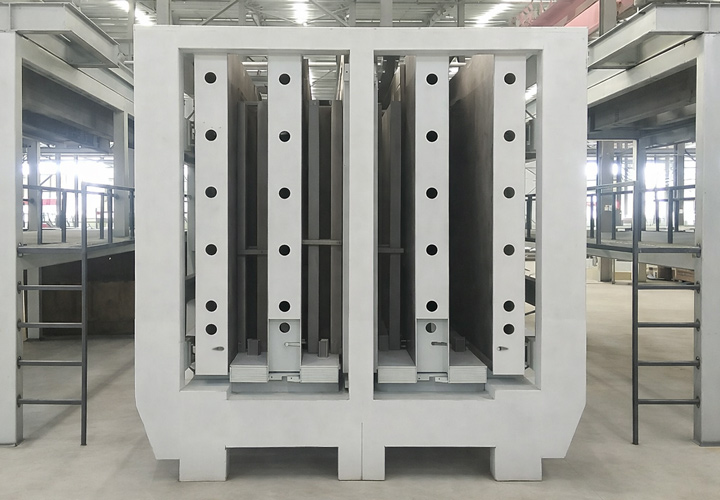
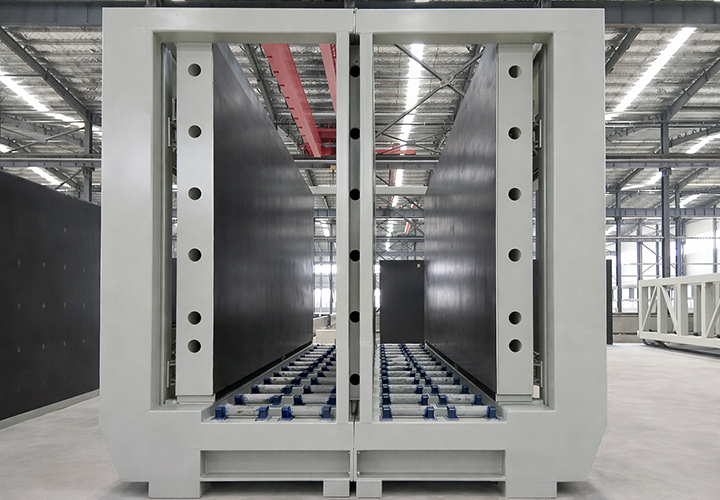
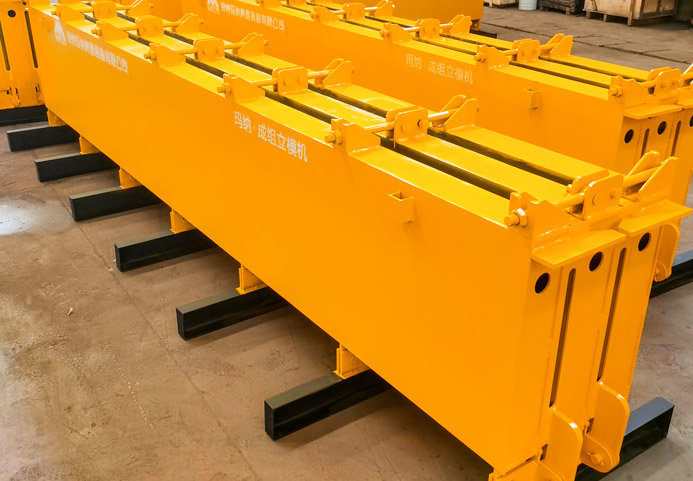
The system is based on a Main-Sub mould forming process, a patented technology in China, combined with a vertical Battery Mould design. In this configuration, the main mould is a fixed, high-rigidity structure, while the T-shaped sub-moulds are movable forming units.
With a configuration ratio of 2:1 or 3:1 between sub-moulds and the main mould, different production stages can operate simultaneously:
One set of sub-moulds is used for mould cleaning, assembly, and installation of embedded parts in a preparation area;
One set is positioned inside the Battery Mould for concrete casting, vibration, and early-stage curing;
Another set completes curing and demoulding outside the main mould.
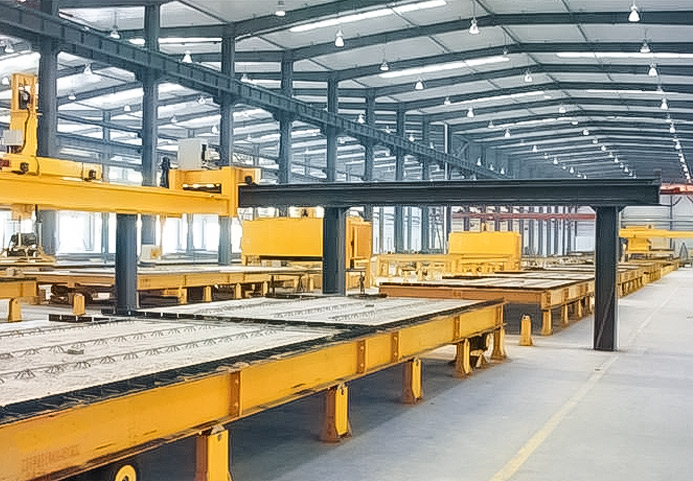
This workstation-based workflow reduces idle time of the main mould and allows multiple operations to proceed in parallel.
Advantages Compared with Conventional Systems
Compared with traditional Battery Mould systems, the Main-Sub Mould System removes most preparation work from the main mould. This greatly improves mould utilization and shortens curing time inside the mould, resulting in higher demoulding frequency. In addition, up to four wall panels can be demoulded in a single operation, further improving production efficiency.
When compared with Casting Beds, the system offers the same or higher output with lower investment and better cost-effectiveness. Double-sided forming ensures excellent surface quality on both sides of the component, while easy assembly, compact footprint, and mobile production capability make the system suitable for both factory and on-site applications, significantly reducing transportation costs.
Equipment Application
The Battery Mould is mainly used for producing precast concrete components with the following dimensions:
Width up to 3500 mm
Length up to 7500 mm
Thickness from 75 to 200 mm
Typical products include precast wall panels and other vertical concrete elements.
Working Environment
The system is designed for stable operation under industrial conditions, with power supply options of 380 V or 220 V at 50 Hz. It can operate in ambient temperatures from −10 °C to 70 °C, with relative humidity up to 80%, in non-corrosive environments.
Key Equipment Features
In terms of production efficiency, each mould can produce up to 24 panels per cycle, with up to two cycles per day, resulting in fast mould turnover and short production cycles.
For product quality, the system achieves dimensional tolerance within ±1 mm/m and surface flatness up to 1 mm/m. Concrete density is uniform, and strength development is stable and reliable.
The automation level is enhanced through PLC control, enabling one-button mould opening and closing, zoned vibration, and real-time curing monitoring. This reduces manual intervention and labor intensity.
The system is also designed for energy efficiency and environmental protection, featuring low installed power, efficient steam curing, and minimal dust and noise emissions.
In terms of operational reliability, the equipment offers a low failure rate, up to 2,000 trouble-free operating cycles, easy maintenance, and a service life of 6–8 years.
Equipment Structure
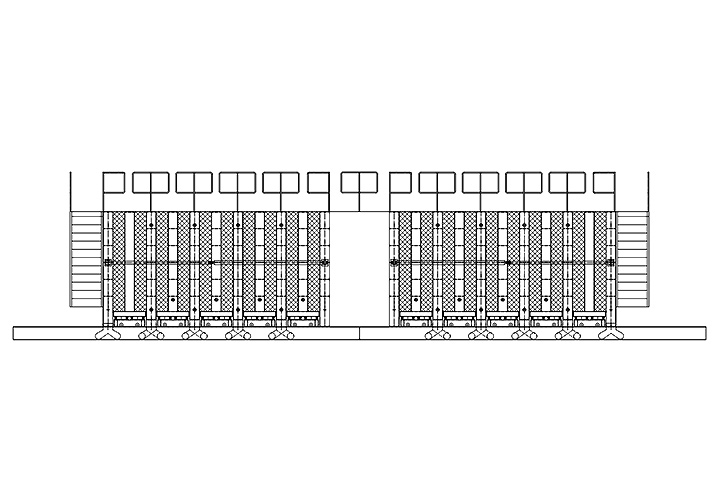
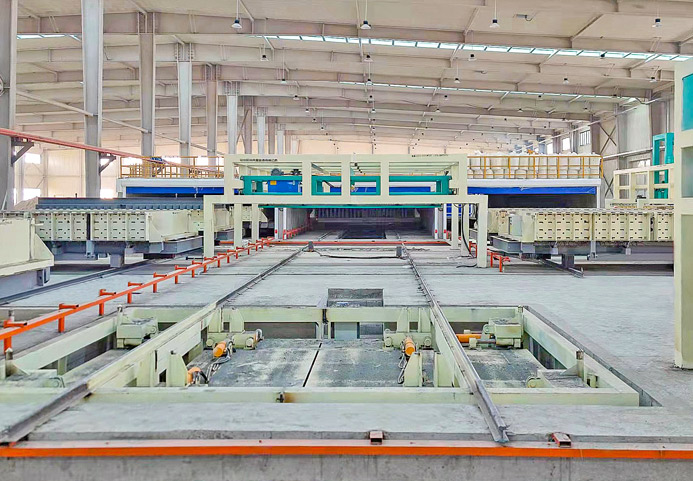
The main Battery Mould adopts a high-rigidity vertical structure with leakage-proof design. Each mould can form 24 precast wall panels in a single cycle. Hydraulic opening and closing of end and side moulds are integrated with vibration and curing systems, supported by an independent hydraulic power station and electrical control system.
Each T-shaped sub-mould can accommodate two wall panels. By adjusting the sub-mould structure, the system can produce not only standard wall panels but also T-shaped, L-shaped, and cross-shaped precast components, providing excellent flexibility for different project requirements.
Production Capacity
T-shaped sub-moulds can be input or output in two sets at a time, handling four or more wall panels per operation. Demoulding and loading time is reduced to approximately one-quarter of that required by conventional systems. Mould preparation work carried out in a fixed preparation area improves efficiency by around 20%, while curing time inside the Battery Mould is shortened to 5–6 hours, compared with 8–9 hours required by conventional methods.
Overall, the Battery Mould can achieve up to double the production capacity of traditional Battery Mould systems.
Conclusion
By combining vertical production, a workstation-based workflow, and an innovative Main-Sub mould design, the Battery Mould provides a highly efficient alternative to Casting Beds. It is an ideal solution for precast concrete manufacturers seeking higher output, lower investment, consistent quality, and flexible production capability.