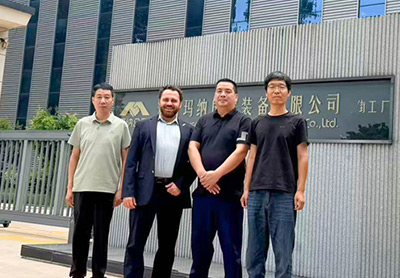
Welcome to Mana Precast


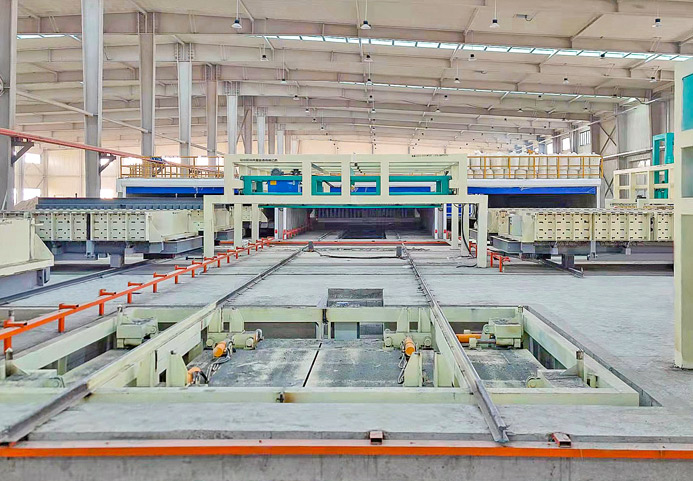
Precast Foamed Concrete Wall Panel Production Line
- High precision
- Easy operation
- Flexible production
| Parameter | Value |
|---|---|
| Annual Capacity | 200,000 – 500,000 m²/year |
| Panel Size (L×W×T) | 3,000 × 600 × (90–200) mm |
| Automation Level | Semi-automatic |
| Compressive Strength | ≥3.5 MPa |
| Dimensional Tolerance | ±1 mm / m |
| Flatness Tolerance | ±1.5 mm over 3 m |
| Required Production Area | 300–3,000 m² |
| Labor Requirement | 4–14 operators per shift |
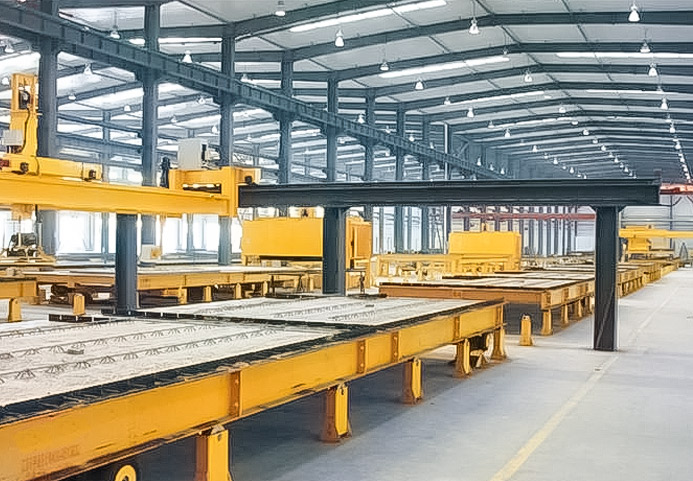
Mana's M05 partition wall panel production line is a mechanised battery moulding system designed for the production of hollow-core wall panels. It features high dimensional accuracy, a stable production process and flexible material compatibility. The line can produce various types of functional wall panels using locally available raw materials.
Features of Foamed Concrete Wall Panels
Vertical Moulding: The vertical moulding process helps produce wall panels with flat surfaces and high dimensional accuracy.
Mechanical Core Tube Insertion and Extraction: Mechanical insertion and extraction of core tubes form hollow sections in the panels, reducing material consumption and panel weight while maintaining the required strength and dimensional stability.
Mechanical Groove Forming: Grooves are formed mechanically, resulting in consistent profiles and smooth, neat edges.
Reinforcing Mesh: Reinforcing mesh is incorporated to improve the mechanical performance of the panels, particularly their resistance to cracking and bending.
Main Equipment
Mixer
The mixing process consists of two stages:
Stage 1: Paste Mixing – Cement, fly ash and water are mixed to prepare the base slurry.
Stage 2: Foam Mixing – Foam, fibres and other additives are incorporated into the base slurry.
Battery Mould
Features a slurry leak-proof design to minimise slurry leakage and ensure accurate moulding. The mould is operated by wireless remote control.
Screeding Machine
Works with the battery mould to remove excess slurry from the top of the mould, improving surface consistency and reducing the need for manual screeding.
Mould Opening and Closing Machine
Opens and closes the end and side moulds of the battery mould system, reducing manual handling during mould operation.
Panel Removal Machine
Once the battery mould reaches this station and is correctly positioned, the panel removal machine pushes the wall panel together with its base mould out of the battery mould and transfers it to the panel closing and tilting machine.
Panel Closing and Tilting Machine
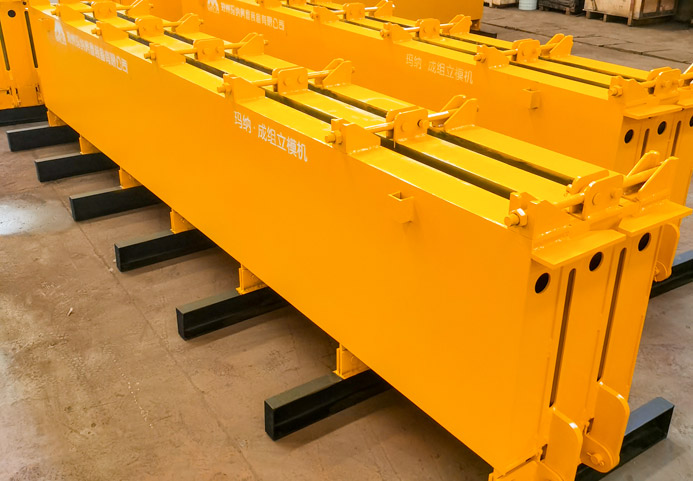
Receives the panels, aligns and joins them, and then rotates the assembled panels by 90°.
Transfer Cart
Transfers the battery mould along the track system. A variable-frequency drive enables smooth and controlled movement.
Production Line Features
Consistent Panel Quality: The panels have smooth surfaces and may not require plastering, depending on the specified surface finish and installation requirements. Their strength, fire resistance and sound insulation performance depend on panel design, materials and testing.
Easy Operation: An integrated electrical and hydraulic control system simplifies operation. Operators can control the main production functions from the control panel.
Flexible Production: The line can accommodate different raw materials and produce panels with various hollow-core configurations. Panel thickness and length can be adjusted to meet different requirements.
Compact Layout: The production line features a compact and efficient layout to save factory space. Equipment installation, commissioning and routine maintenance are designed to be straightforward.
Production Process:

Mould Cleaning: Remove dust and residual material from the moulds.
Mixing: Prepare the base slurry and incorporate foam, fibres and other additives.
Release Agent Application: Spray release agent onto the mould surfaces.
Mould Closing: Close and secure the mould.
Tube Insertion: Insert the core tubes into the mould to form the hollow sections.
Pouring: Pour the prepared slurry evenly into the mould.
Curing: Cure the panels until they reach the required demoulding strength.
Tube Extraction: Mechanically extract the core tubes from the mould.
Demoulding: Open the mould and remove the formed panels.
Value-Added Services
Provide factory layout proposals and market feasibility reports to support project planning.
Provide modular production line configurations, allowing customers to select equipment combinations according to their production requirements and investment plans.
Provide equipment installation and commissioning services, including guidance on operating the production line.
Provide follow-up technical support and production line optimisation and upgrading services.