Welcome to Mana Precast
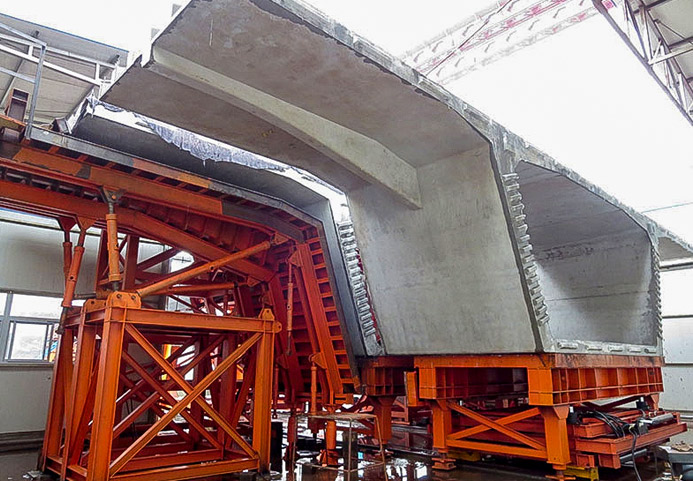
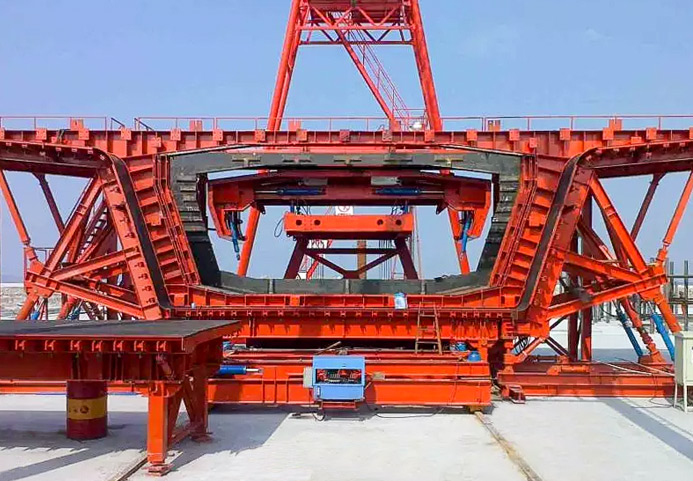
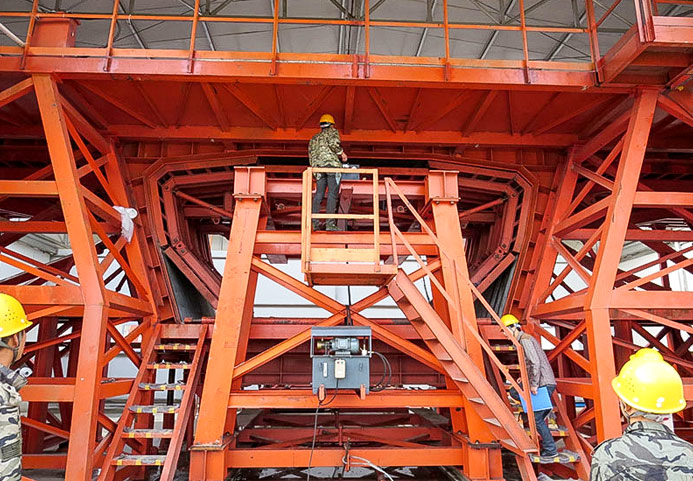
Precast Segmental Box Girder Bridge Formwork
- Strong integrity and high stiffness
- Applicable to various box girder specifications
- Good surface finish, relatively low cost
Precast concrete segmental beams are constructed by dividing the main beam lengthwise into several segments, which are precast in a factory. After curing, these segments are assembled into a complete bridge structure by tensioning the pre-stressed tendons. This construction method accelerates construction progress, ensures engineering quality, and reduces the impact on the environment and existing traffic.
Formwork is one of the key elements in the production of precast box girder sections as it directly affects the appearance and dimensional accuracy of the box girders. Therefore, the formwork must meet the standard requirements for precast box girders.
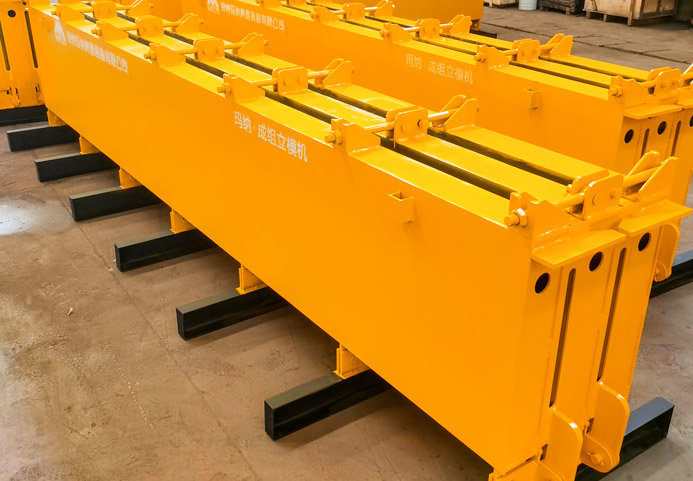
The components of precast box girder formwork can be divided into external and internal moulds, with the external mould consisting of the end mould, side mould, and bottom mould. All forms from Mana are made with mechanical processing, focusing on controlling the flatness of the bottom mould, the dimensions of the embedded part positioning grooves, and the precision of the edge and core mould rebar positioning holes.
Features of Mana Precast Segmental Box Girder Bridge Formwork:
Suitable for a wide range of box girder specifications at a relatively low cost.
Strong formwork integrity, high stiffness, and excellent surface finish.
Reduced labour intensity and enhanced overall safety.
Quality Control Measures:
To ensure the dimensional accuracy and surface finish of the precast box girder moulds, the following measures have been implemented during the design and manufacturing process:
High-precision machining: All formwork components are machined on high-precision tools to ensure assembly accuracy and the overall quality of each component.
Surface treatment: The formwork surfaces undergo professional treatment to achieve a high degree of smoothness and cleanliness, reducing the likelihood of surface defects after concreting.
Quality control: Before the formwork is dispatched from the factory, it undergoes strict quality inspections, including size checks, appearance inspections, and assembly tests, to ensure its reliability and durability in use.
Production Process of Precast Box Girder Segments:
Production Process of Precast Box Girder Segments:
Laying the bottom mould.
Rebar processing and binding, installation of corrugated pipes.
Installation of side moulds and end moulds.
Installation of internal mould (binding of top slab rebar).
Concrete pouring.
Formwork removal and curing.
Insertion and tensioning of steel strands.
Grouting and end sealing.
Beam relocation and storage.
Precautions for the Use of Steel Moulds:
When not in use, store the steel formwork in a location that avoids direct sunlight, rain, and other adverse conditions. Ensure it is well protected from moisture to prevent rusting due to prolonged storage. Applying anti-rust oil to the surface of the steel formwork is recommended.
During the construction process, ensure timely cleaning of the steel formwork's surface.
If rust appears on the steel formwork's surface, it should be thoroughly de-rusted before reapplying the protective coating.
The steel formwork should be assembled strictly according to the assembly drawings to prevent damage caused by improper handling.
If serious corrosion or deformation is detected, contact the manufacturer immediately for repair or replacement.